


Pull a shift paddle in the 2026 Honda Prelude and the car responds with a gear change that isn’t a gear change. That sounds like a strange way to revive a coupe remembered for its engineering. It also makes the new Prelude a useful reminder: this nameplate has a history of questioning how a sporty car should work.
The interesting comparison isn’t simply old versus new, or gasoline versus electricity. It is between two approaches to making the driver feel involved. One added an elaborate mechanical connection to the rear wheels. The other uses software to create familiar sensations from a very different powertrain.
In 1987, the clever part was at the back
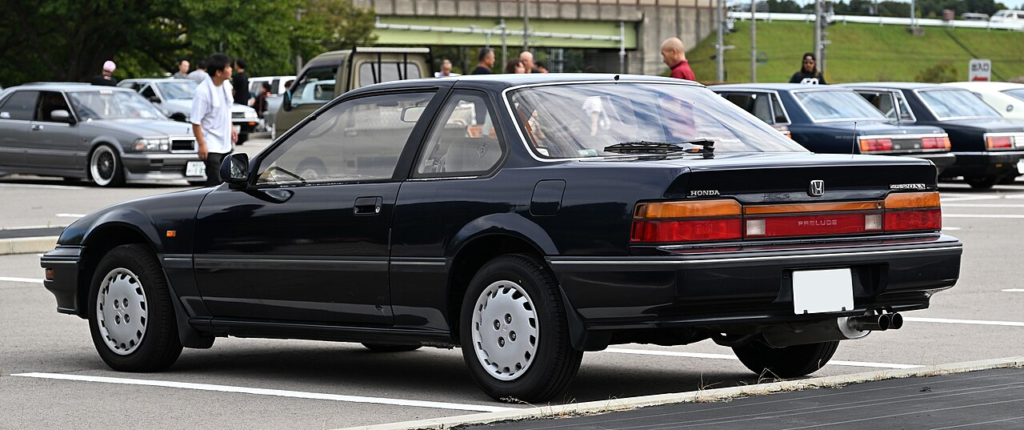
Honda introduced its steering-angle-sensing four-wheel-steering system on the Prelude in April 1987. As Honda’s engineering history explains, the system’s development grew out of research into vehicle stability and maneuverability. Its distinctive trick was responding to the amount of steering-wheel movement.
With small steering inputs, the rear wheels turned in the same direction as the fronts. With a larger input, they turned the opposite way. This was a mechanical system governed by steering angle; describing it simply as a device that switched behavior according to road speed misses what made it unusual.
It was an ambitious answer to a practical question. Could a front-wheel-drive coupe use its rear wheels more actively, rather than asking them merely to follow? The hardware made that question visible. You could look at the rear tires and see something unexpected happening.
The hybrid changes the conversation

The 2026 U.S.-market Prelude uses a two-motor hybrid system rated at 200 horsepower. In Honda’s launch description, it has neither a conventional stepped transmission nor a belt-and-pulley CVT. Its S+ Shift mode coordinates engine speed and motor response to simulate shifting, including responses to the steering-wheel paddles.
That distinction matters. The paddles aren’t selecting physical gears in an eight-speed gearbox. They are requesting a programmed response. Honda also fitted chassis hardware shared with the Civic Type R, including dual-axis front struts and substantial brakes, with tuning specific to the Prelude.
Does a familiar sensation need familiar hardware?

There is a reasonable enthusiast objection here: why add an imitation of something the powertrain doesn’t require? There is an equally reasonable answer. A driver’s relationship with a car includes rhythm, anticipation and feedback, not just the efficiency of getting power to the road. An acceleration curve can be smooth and effective while leaving someone wanting more to do.
Whether Honda’s solution is satisfying is a question for driving, rather than a conclusion to borrow from a specification sheet. A simulated shift is neither automatically engaging nor automatically pointless. The useful test is whether the response feels consistent, understandable and worth choosing over the normal hybrid mode.
The old four-wheel-steering Prelude and the new hybrid aren’t delivering the same experience. Their connection is a willingness to make an ordinary-looking coupe carry an unusual idea. For a returning nameplate, that is a more interesting inheritance than a familiar badge alone.

Leave a Reply
You must be logged in to post a comment.
Create an account to comment