


Today, the Chevrolet Corvette is one of the most enduring names in automotive history. In 1955, however, its future was anything but secure.
The first Corvette looked exotic, but buyers quickly discovered that its performance didn’t quite match the styling. Sales disappointed, competitors were arriving, and Chevrolet had legitimate reason to wonder whether its fiberglass sports car was worth continuing. What ultimately saved the Corvette was a combination of new V8 power, a relentless engineer named Zora Arkus-Duntov and, quite ironically, Ford.
The First Corvette Looked Faster Than It Was

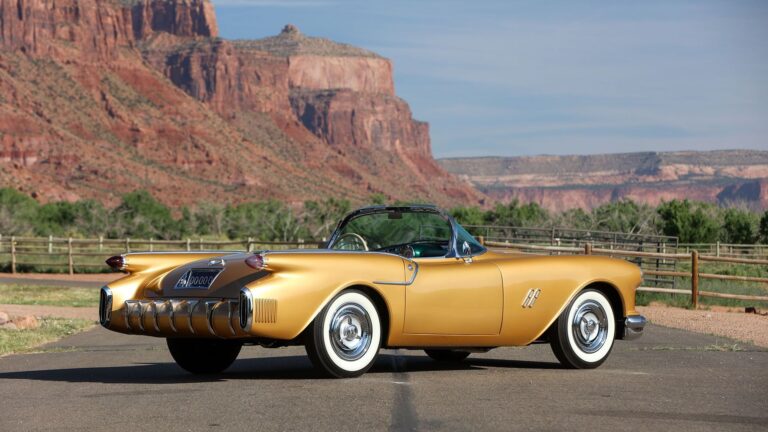
Chevrolet unveiled the Corvette at GM’s Motorama in January 1953, where the sleek fiberglass two-seater generated enough excitement to convince the company to put it into production. Just 300 were built that first year, all finished in Polo White with red interiors.
Under the body, though, the Corvette was much less exotic. Its 235-cubic-inch “Blue Flame” inline-six produced 150 horsepower and was paired exclusively with a two-speed Powerglide automatic. Early cars also lacked roll-up windows and exterior door handles. The Corvette looked like an American answer to European sports cars, but enthusiasts expecting Jaguar-like performance were often disappointed.
Chevrolet increased production dramatically for 1954, building 3,640 Corvettes, but demand never caught up with expectations. The St. Louis plant had been equipped to produce far more. By the following year, sales collapsed to only about 700 cars. For a new model without an established customer base, the numbers were alarming enough to raise serious questions about whether Corvette should continue at all.
Then Ford Built the Thunderbird

Ford introduced the Thunderbird for 1955, and buyers responded immediately. Unlike the early Corvette, the Thunderbird came with V8 power from the start and was marketed more as a stylish “personal car” than a pure sports car. Ford sold more than 16,000 Thunderbirds in its first model year—while Chevrolet managed only around 700 Corvettes.
That success may have been exactly what Corvette needed. With Ford proving there was a substantial American market for sporty two-seat cars, Chevrolet suddenly had a reason not to abandon its own. Corvette also finally received the engine it should arguably have had from the beginning: Chevrolet’s new 265-cubic-inch small-block V8. Rated at 195 horsepower in the Corvette, the V8 transformed the character of the car. A three-speed manual transmission also became available late in the model year.
Helping push Corvette in that direction was Zora Arkus-Duntov. The Belgian-born engineer had seen the original Corvette at the 1953 Motorama and loved its appearance while recognizing its performance shortcomings. After joining GM, Duntov became one of the strongest internal advocates for turning Corvette into a genuine high-performance machine rather than allowing it to remain simply a stylish roadster.
Corvette Finally Became the Car It Looked Like

For 1956, Chevrolet substantially redesigned the Corvette. The new body introduced the famous side coves, along with practical improvements including exterior door handles and roll-up windows. More importantly, V8 power was now standard. Corvette was beginning to look—and behave—like a serious sports car.
Then came 1957. Chevrolet enlarged the V8 to 283 cubic inches and offered Rochester mechanical fuel injection. In its highest-performance form, the engine produced one horsepower per cubic inch: 283 horsepower from 283 cubic inches. A four-speed manual became available as well. Under Duntov’s influence, Corvettes increasingly appeared at racetracks alongside European machinery, giving Chevrolet the performance credibility the original car had lacked.
The sales numbers began moving in the right direction. Chevrolet produced more than 6,000 Corvettes for 1957, and the model eventually grew into a permanent part of the company’s identity. But that outcome was hardly inevitable. Just a few years earlier, Corvette had been an expensive experiment with disappointing sales and an uncertain future. Ironically, one of the cars that helped justify saving it wore a Ford badge.
Leave a Reply
You must be logged in to post a comment.
Create an account to comment